March 31st, 2017 by Maura A. Smale · No Comments
I am on sabbatical this semester, and one of the things I’m working on is a qualitative study of undergraduate attitudes and practices around their course reading. I’m interviewing 10 students each at 3 CUNY colleges to learn more about how they get access to their course reading, what their process is when they read, and how they prioritize and manage their reading assignments. A preliminary literature search last year as I was proposing this project revealed lots of sources about strategies to encourage students to do the reading, and recent reports by the Student PIRGs among others have discussed the link between high (and increasing) textbook costs and student access to course readings. But I wanted to learn more about the nuances in students’ reading practices from students themselves.
I’m nearly finished with interviews though I still have transcription, coding, and analysis to go. But one particular data point that many* students shared has been nagging at me so much that I’m not willing to wait to write about it: the requirement in some courses for students to purchase access to an online bundled textbook/homework platform in order to take the class. Some of these platforms include additional tutorials or other curricular materials. Some offer a few pricing tiers, e.g. a lower cost for homework only than for homework + etextbook than for homework + etextbook + print textbook. All are required, that is to say that students must submit their homework via the platform in order to participate in the class.
* How many? I’m not sure yet, I haven’t analyzed the data! But more than one.
This is not a completely new thing in textbook publishing, and indeed is the topic of a PIRG report from last fall (which is on my to read list). And I’m fairly far away from my own college experience at this point, too, so I’m willing to concede a little bit of the fear of the newfangled in my reaction. But I’m frankly horrified by the potential for increasing reliance on these textbook/homework platforms. Among my many concerns:
– Ultimately, some students will not be able to take classes in which these platforms are the only way to access their required homework/assignments, because they cannot afford to buy access to those platforms. This is especially relevant at CUNY, where 58.3% of our undergraduates receive federal Pell Grants and 38.5% have an annual household income of less than $20,000.
– College students are (and have ever been) savvy about getting their course materials. I’m hearing a wide range of strategies from the students I interviewed, from buying their books used at online or physical booksellers, to buying from other students, to borrowing from friends or classmates, to renting an online or print textbook. There’s no way to borrow a homework platform code from your friend, or to sell the code to another student after you’ve finished the class.
– Many college libraries don’t offer course texts for their students, but at CUNY most of us do. At City Tech we have some (not all) textbooks on reserve for in-library use and we move older editions into the circulating collections for students to check out for longer periods. There is no way for the library to offer access to homework platform codes, since they are tied individually to each student.
I know, I know, publishers gotta publish, and capitalism exists. But textbook prices have risen well above the rate of inflation, and with the rise of open educational resources (OER) it’s clear that publishers are exploring alternative ways to keep their profits up. Earlier this week I had an exchange on Twitter with a few library colleagues about a column on Inside Higher Ed that suggests that OERs are not nearly as effective as are personalized learning systems (another flavor of textbook platform). The author posits that:
[I]t is misguided to assume that the difference between open educational resources and paid resources is merely one of cost. […] The reality is that there are simply no open resources that are as flexible, reliable or impactful as the newest generation of education resources.
I was not surprised to see that the author is on the advisory council of a large textbook publishing corporation. I would counter that the negative impact on graduation rates when a student cannot take a course required in their major because they cannot afford to pay for the textbook platform code is far worse than the lack of personalization features in freely-available OERs. Our students are literally paying the price, and it’s a price that many of them cannot afford.
Tags: Uncategorized
February 4th, 2014 by Maura A. Smale · 1 Comment
Last weekend I found myself in a room chock full of 30+ students, teachers, and other interested feminists with laptops at the Art+Feminism Wikipedia Edit-a-thon. As the organizers introduced the event and its goals, several participants with relevant expertise (historians, art scholars) identified themselves and volunteered their assistance. I’m not an art historian, but I raised my hand anyway and came clean as an academic librarian, offering to help with research questions if folks had them.
And then I got perhaps the most amazingly gratifying response ever, as the whole room made an audible “Oooooooh!” sound at the mention of the word “librarian.” True story! (and one that’s kept me smiling for days)
With that auspicious beginning to my first ever Wikipedia edit-a-thon I was primed to have a great time, and the event did not disappoint. Edit-a-thons were happening on February 1st all over the world: I chose to go to the session at the Brooklyn Museum, held in the Elizabeth A. Sackler Center for Feminist Art in a room adjacent to The Dinner Party (how’s that for inspiration?).
While I’ve been a heavy user of Wikipedia for years and refer to it often in my research and information literacy instruction with City Tech students, I’d never edited Wikipedia before last weekend. I came in feeling a bit nervous about my n00b status and wondering about the cliquish-ness of the frequent-editors in the Wikipedia community, as I’m well aware of the under-representation of new voices and especially women on the site. But I think I might be hooked now — it was a huge thrill to contribute to the site, and I’m happy to report that my (small) edits have persisted even to today.
A couple of takeaways for me:
OMG yes, it’s so very clear that our students should be contributing to Wikipedia. I felt this way even before going to the edit-a-thon, but I feel even more strongly about it now. It might be tricky to add Wikipedia editing/content creation to the credit-bearing course we teach at my library, as the content we cover include the information landscape and issues like access to information, intellectual property, and information ethics — all concepts that are likely to be heavily-covered (and possibly contested) in Wikipedia. But I’m going to keep thinking on a way to try, because it seems so much better to have the content that students create available for others to use. And I’m delighted that the graduate students in the course I’m co-teaching with Michael Mandiberg, Interactive Technology and Pedagogy Core 2, will have the chance to edit Wikipedia this semester.
Time: working on Wikipedia takes time, which can be in short supply. Time to research, time to cite, time to write. The organizers of the edit-a-thon had compiled a list of Wikipedia entries that needed work and I chose to work on the entry for Aebbe the Younger, an Abbess in Dark Age Scotland (later sainted) who apparently convinced her fellow nuns to disfigure their faces as Vikings were poised to attack the monastery, thus avoiding rape (though the Vikings did set fire to the monastery and all reportedly perished). Back in the day when I was an archaeologist my research (for a time) centered on the Iron Age through Medieval British Isles, so this entry piqued my interest. But I’d forgotten how little is really known about this time period, even in this area which is relatively rich in historical documentation. I spent most of my edit-a-thon time last Saturday doing research on the open internet as well as in library databases, but found little in the way of new information. I was able to add a couple of citations, and I have copious notes and intend to go back and flesh out the entry more, as well as tidy up/add citations to a couple of other references to Aebbe in other Wikipedia entries. But sometimes an entry is short because there’s just not that much information out there, unfortunately.
Even despite these challenges, the edit-a-thon convinced me to do more editing in Wikipedia in the future. So I count that as a win, and I’m looking forward to getting back to Aebbe’s entry as soon as I can.
Tags: Uncategorized
August 27th, 2013 by Maura A. Smale · 1 Comment
It’s that time again. Classes at City Tech start tomorrow, and amidst all of the prep for the returning students (and orientation last week) I’ve started to take stock of my summer. It’s all too easy to take a glance at that (perhaps overly) ambitious summer scholarly to do list and feel mopey about all of the things that didn’t get finished. And with the competition inherent in academic life, the slide down into “but I didn’t get nearly as much done as everyone else did” -itis is a quick and easy drop.

But not this year! Last week University of New Orleans Sociology prof @drcompton tweeted an alternative strategy for dealing with those late summer academic doldrums:
I like this strategy. I like it a lot. So much that I’ve been thinking about it for a few days now, mentally assembling the items for my list. Focusing on the dids rather than the didn’ts has been a welcome antidote to the beginning-of-the-semester jitters.
Here’s my I Did List for summer 2013:
– thoroughly outlined the second half of our book, finished a chapter, began work on the final chapter (woo!)
– prepared and sent two book proposals to university presses
– hired our Data Visualization Assistant and began work on visualizing the data from our study of student scholarly habits
– met with coauthors to kick off work on two new articles, and started writing a draft of my part of one of them
– attended the JustPublics@365 MediaCamp workshop on writing op-eds and essays (which was fantastic!)
– wrote an op-ed and sent it to the New York Times (they rejected it, which was stinky, but writing it was good practice)
– made the last revisions with my coauthors and finished an article about open access policies, and submitted it to a journal
There were other things too — leisure reading, library and other work tasks, and even some vacation. But it’s super satisfying to see all of my completed scholarly tasks in one place. Of course there are still lingering items on the list that haven’t been crossed off…yet.
Image by Johan Hansson
Tags: Uncategorized
May 11th, 2013 by Maura A. Smale · 3 Comments
One of my college experiences that I’m most grateful for is the opportunity I had to do my academic work in a wide variety of libraries and other spaces. These days my research and writing mostly happens in two locations: my office, sometimes before the library opens (though my office is in a very quiet part of the library, so even with the door open it’s never loud), or at home, where I have a laptop and vary my workspace slightly based on the time of day (mornings are sunny in the living/dining room, afternoons sunnier in the bedroom where my desk is). I know I can work in other places — my laptop is heavy, but not too heavy to take to a public library (we have so many wonderful library options in NYC), a coffee shop, etc. — but usually I don’t. Those places always seem so far away, and I have a hard time convincing myself to spend time and money commuting just to vary my study location, especially when I only have a few hours for that work.
But college was different. I was reminded of this not too long ago when I learned about a nifty libraries promo at the University of Chicago. They’ve made a set of small buttons with the name of each of the 6 libraries on campus. (Full disclosure: I had a radio show in college so these buttons also make me happy because they remind me of my youthful DJing and show-going days.)
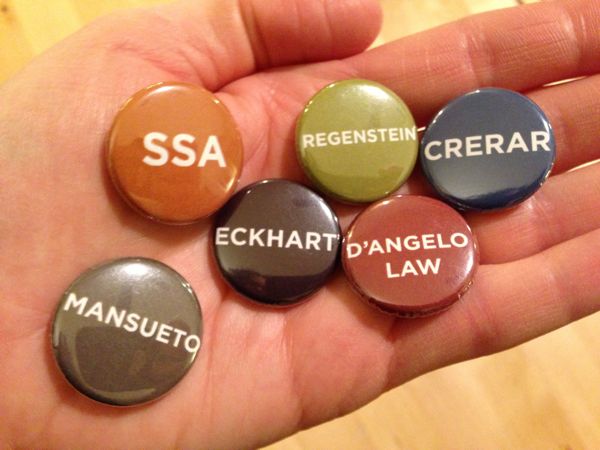
I tweeted a photo of the buttons which sparked a quick conversation with friends and other alums about the places we studied. One of my favorites as an undergrad was Harper Library’s reading room, a very traditional space with high ceilings, tall narrow windows, dark wood tables, and bookshelf-lined walls. I loved Harper — it was the perfect environment for sustained reading and taking notes (from what I understand it’s now no longer a lending library but remains a study space). For more utilitarian, everyday schoolwork I went to the Regenstein, the main humanities/social sciences library on campus (also where my friends hung out). By third year I had a locker and a favorite carrel just adjacent; my then (and current) partner worked in the coffee shop on the lower level. If I had serious, uninterruptable work to do I’d sometimes go to Crerar, the science library. It was farther away from my dorm (and then apartment) than the other libraries, and it’s main advantages were that it was utterly silent and it was unlikely that any of my friends would be there, so I wouldn’t be tempted to socialize when I should be studying.
I’m a librarian so of course I love libraries, that’s no surprise. But as we’re heading into finals I’m reminded again about space: finding adequate space for academic work (and how lucky I was to have so many options). I walk through the library and students are everywhere. Every seat is filled, at carrels and tables, and students are even perched on kickstools in-between the stacks — though to be fair, many of them are seeking electrical outlets, which are occasionally located on pillars throughout the stacks. I love to see the library so full, but worry that we don’t have enough space for our students or enough different types of space.
Space is a luxury, it’s true, and City Tech has a small campus in a dense part of Brooklyn. What can we do in the libraries on our space-constrained campuses? Are there small steps we can take to ensure that students have the space they need to do their academic work? That’s one of the things my research partner and I are thinking about and grappling with right now as we write up our study of CUNY students’ scholarly habits. I’ve been cheered to read about a small academic library that established a silent study room — might there be space for something like that at our library? Could we rearrange or remove stacks to create quiet and less quiet zones? I’m looking forward to pulling together (and sharing!) these recommendations from our research.
Tags: Uncategorized
March 10th, 2013 by Maura A. Smale · 4 Comments
As my research partner and I have been wrapping up our research project I’ve been thinking about all of the data we have that we’re not going to use for the book we’re in the midst of writing. We have transcripts from interviews with 178 students and 63 faculty; we have photographs from 60 students and maps and drawings from over 100, as well as syllabi and assignments from faculty. We have a LOT of data. And then I read a great post not too long ago by art historian Renee McGarry on a similar theme, about the objects she’s researched that haven’t made it into her writing.
Such is the nature of research, though maybe studies like ours, in which we started by asking open-ended questions of the participants, are more susceptible to it. It’s good to have lots of data from our study, certainly better to have too much than too little. We’ve ended up with some “extra” data: stuff that’s not necessarily relevant to our plan for the book. It’s not a ton of data, certainly the minority. But sometimes I get a little sad when I think about it. Collecting data is time-consuming; we spent 2 years traveling around CUNY talking to students and faculty, experiencing, just a little bit, the commuter scholar lifestyle of our students. I’m also a no-leftovers, waste not want not kind of person, so it pains me a bit to think of the insights from interviews and images that we won’t include in the book. Our participants shared so much with us, and I want to be sure that we do justice to them and their stories.
But those data aren’t necessarily irrelevant either; they all say something, even if those somethings don’t fit into the narrative we’re weaving together for the book. We can return to some of them–the side conversations and explanations, the material culture in photographs and drawings that doesn’t primarily speak to students’ lives as scholars–later, after the book is finished, and analyze them further. To this end I’ve started a list of the very beginnings of ideas I have about some of the information we gathered, ideas that don’t work for the book but could turn into something else, maybe. The list has made me feel a bit better about the data left behind. It’s not going away, it’s just waiting, patiently, for us to have a chance to think on it more thoroughly, and to give it the respect and consideration it’s due.
Tags: Uncategorized
July 29th, 2012 by Maura A. Smale · 1 Comment
Library tourism! Do all librarians love it? I think signs (probably) point to yes.
Last month we took a quick vacation to visit family and friends in the Midwest and had the chance to indulge in some library tourism, too, in a visit to the new Joe and Rika Mansueto Library at the University of Chicago. Even if you’re not a library nerd you may have heard about Mansueto: last fall Wired ran a short piece about it last year when it opened.
Lots of large research libraries have run into trouble storing their collections in recent years as their available shelfspace has filled to capacity. Some of those libraries contract with offsite storage facilities, typically a good ways away from the campus, which deliver requested books daily. At the U of C they decided to turn the tennis courts next to the enormous Regenstein Library (the main non-science library on campus) into an onsite storage area…using the power of robots!
Mansueto is not tall aboveground but cuts an imposing figure nonetheless: a broad glass oval-shaped dome on the lawn. The dome encloses an incredibly quiet reading room and a preservation and conservation laboratory (very cool, like the visible science exhibits at natural history museums), divided in the middle by the circulation desk. But the real secret is below: a book storage system that reaches 50 feet down underground and uses robotic cranes to retrieve items requested by readers. The robot library of the future!
Unfortunately there weren’t any tours happening on the day we visited, so I can’t share any crazy robot photos with you, but there are some cool videos on the Mansueto website if you’d like to check out the robots.
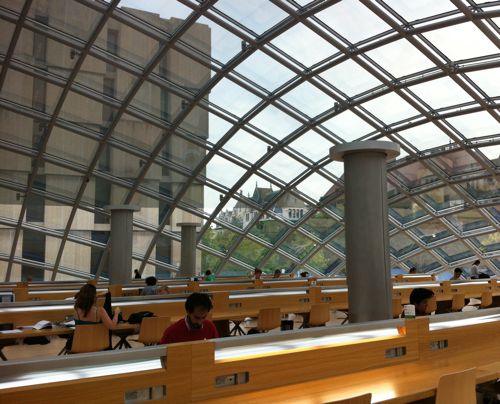
I felt a little guilty even walking around the space — it was really quiet, and I think we got the stinkeye more than once as we tried to tiptoe around. The reading room has long tables with lighting and outlets and I could instantly see myself getting lots of work done in that kind of space. Have I mentioned how quiet it was?
There were also a few study rooms — essentially glass cubes with a desk and chair inside. They’re really beautiful.
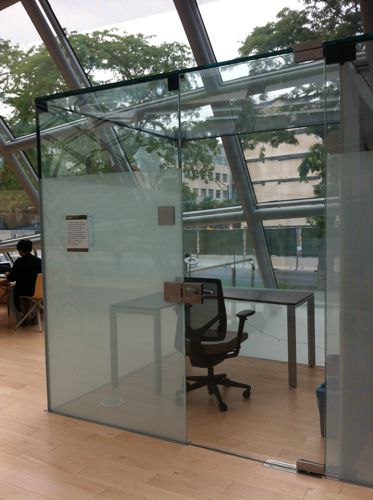
It strikes me that these glass cubes might be a good solution for libraries that want to add study rooms in spots that weren’t originally designed for them. For example, at City Tech we have a 2-story library with one long wall of windows. We’ve been thinking of doing some rearranging so that we could accommodate more study rooms, but we probably don’t want to put them along the windows because that would restrict the amount of natural light that the rest of the library gets. A glass cube study room could go anywhere, even in the middle of a room. As @lwaltzer and the U of C responded to a tweet of mine, we could call them thinkquariums or think tanks!
Tags: Uncategorized
May 4th, 2012 by Maura A. Smale · No Comments
A couple of weeks ago I went to see a band I’ve loved for ages play a show. They don’t play live much — one of them lives in Brooklyn and the other in London — and it was a sweet treat to hear so many of my favorite songs. They played one song in particular that I really like and haven’t heard recently when I listen to their CDs on my computer or phone. After wondering whether it was a new or unreleased track, a bit of digging revealed that I do actually own the album that includes the song, and in fact the album itself is in my Itunes. But Itunes had been skipping over it, as if it didn’t even exist. Somewhere after some update Itunes had decided that I don’t have the rights to listen to it anymore, because my partner had bought the album for my birthday a few years ago, and Itunes was pegging it to his account rather than mine.
Once I figured things out it wasn’t hard to get the album back into my regular listening rotation. But this small annoyance illustrates a bigger issue: the problems created by digital rights management (DRM). Today is the International Day Against DRM, advocacy initiated by the Free Software Foundation. The FSF’s Defective By Design campaign seeks to eliminate the restrictions to digital media use imposed by DRM. While DRM is intended to combat piracy and other illegal uses of music, ebooks, movies, software, and other media, it also restricts uses that seem perfectly reasonable from a user’s perspective. And while (as the website notes) DRM has become much less prevalent in music recently, other media are still very much affected.
DRM is an enormous thorn in the side of academic, public, and other libraries. Cory Doctorow’s article in the Guardian yesterday, which discusses scifi publisher Tor Books’ decision to stop using DRM on its ebooks, covers many of the issues around DRM well. Some that are most pressing for libraries include:
Formats
With the proliferation of ebook formats the landscape is cluttered and complex, and it can be difficult to determine which ebooks can be read on which devices. This hurts libraries and readers immensely. Like many libraries we’ve acquired lots of ebooks recently which seems like good news for our students and faculty on the face of it: we’re a small physical space and our readers have long commutes, so ebooks could be super useful. But the barriers to actually getting that content on your device are so high, requiring many confusing steps and sometimes including downloading additional proprietary software. While my colleague Allie Verbovetskaya created an awesome handout to guide our users, I still worry that it’s just too much to bother with.
Number of Users
One of the wonderful things about digital media is that it’s easy to allow multiple, simultaneous uses. This is a feature, not a bug, but DRM seeks to restrict multiple uses. Don’t get me wrong: writers write, publishers publish, and I believe that both deserve to get paid for their work. But I think there’s something wrong when I have to wait 6 wks to read an ebook from my public library because someone else has it “checked out,” or when only 1 student at a time can read an etextbook because the publisher’s price for a license that supports multiple readers is prohibitively expensive. There has to be a better way.
So Happy Day Against DRM! Learn more on the Defective by Design website, which includes a guide to DRM-free media and other great resources:
And for more on library-specific DRM issues, check out the Readers Bill of Rights, Alycia Sellie of Brooklyn College and Matthew Goins’s wonderful project:

Tags: Uncategorized
March 22nd, 2012 by Maura A. Smale · No Comments
Recently we were at housewarming party for our friends and one of their son’s games caught my eye: Rivers, Roads, and Rails. It’s a simple matching game consisting of cardboard tiles each depicting a combination of a river, road, or rail segment. Players start with 7 tiles and go ‘round placing tiles to match the segments on the floor. The instructions in the box were sketchy, so we added that if a player can’t place a tile, draw from the facedown pile, place it if you can, and keep it in your hand if not. The game is physically lovely as well: the cardboard tiles are thick and sturdy, and the illustrations are pretty and whimsical.

Interestingly, we couldn’t convince any of the kids at the party, aged 2-10, to play the game with us, so gameplay involved 5 of us, all adults. And a rollicking good time was had by all: we found ourselves telling little stories about the segments and associated pictures on the tiles, and ended up being more interested in the possibility of connecting every tile to the board than of someone winning (we had decided that the first person to place all tiles in their hand was the winner).
One aspect of Rivers, Roads, and Rails that I really enjoyed is that the game board is created in the process of gameplay. Carcassonne, one of my favorite board games, uses the same mechanic: players draw tiles with segments of cities, roads, and fields, then place their pieces (called meeples) to claim features, each with different point values. The game ends when the last tile is placed and whomever has racked up the most points is the winner. It’s a fantastic game: the basics are easy enough to grasp to make it fun for beginners, but there’s also real strategy possible which keeps more experienced players engaged.
But what does any of this have to do with the library? I’ve been thinking lately about ways to incorporate more games and game mechanics into my library and information literacy instruction, and speculating on the possibilities for games that could help our students with their research assignments. Because the mechanic described above, which I like to think of as “we make the board by playing” (a riff on the title of a book designed for first year experience coursework called College: We Make the Road by Walking), is so interesting to me, I’ve found myself considering how to use it in research instruction.
In some ways the experience of building a game space as you play the game is very similar to the process of doing research for an assignment: you begin with some parameters (taking your turn or coming up with a research topic), you take an action (draw a tile, start your search [engine]), you figure out what to do with what you get (place your tile, use or reject your search results), and then you adjust accordingly the next time around. In a tile matching game the landscape shifts with every turn, just as it does in the research process as topics broaden or narrow, and the iterative nature of research means that the sources we find mold and change our topics, which feeds back into how and where we search for sources.
It’s all very well to point out the similarities between the research process and a tile matching game, but how can we actually use that to help students learn how to do research? I’m not convinced that creating a game to teach research competencies that is itself separate from students’ research needs, most often determined by the requirements of the research projects assigned in their courses, is the best way to proceed. But I wonder whether the research journal connects well with the tile matching mechanic?
Sometimes students are required to keep a journal of their research process, which they may have to hand in along with their research paper, presentation, or project. At its best the research journal forms a kind of story of the journey students take as they do research: the hesitant beginnings, wrong turns, forks in the road, unexpected shortcuts, and (hopefully) the successful outcome of completing the research needed to finish their project. And we hope that students find it useful to reflect on their own research process, and that they begin to understand the iterative nature of research, that it’s not just a straight line from point A to point B. What if we asked students to create a game that tells the story of their research rather than keeping a research journal? Would students achieve the same goals of recording and reflecting that they do with a traditional research journal? I’m not sure, but I’m considering giving it a try the next time I teach my department’s research and documentation course (and I’ll report back if I do).
Tags: Uncategorized
October 23rd, 2011 by Maura A. Smale · 8 Comments
I’ve been an open access publishing advocate ever since I first wrapped my head around what’s often termed the scholarly communication crisis. To briefly sketch out an admittedly complex issue: researchers write and peer review articles, journals publish them (without payment to the researchers), and libraries buy back the journals at prices that have increased a staggering amount over the past 30 years. I was late to the OA advocacy game, and am somewhat ashamed to admit my utter ignorance of the economics of scholarly publishing when I was completing my degree in anthropology many years ago. But when I went back for my degree in library and information science it suddenly became so clear that the current subscription journal-based system of publishing academic research is not working anymore, not for the libraries with shrinking budgets, not for the researchers who want to share their work with as wide an audience as possible, and certainly not for the taxpaying-public who are funding many research studies yet cannot access the articles about their results.
Open Access Week begins tomorrow, the 5th year for this international advocacy event. In honor of OA Week I’d like to share my personal open access pledge. It’s not original — lots of other scholars and researchers are doing it, from institutions like Harvard and Kansas State and Oberlin, to library faculty members at Oregon State University and Gustavus Adolphus College, to individuals like danah boyd and Jason Baird Jackson. It’s a small step, but I’m convinced it’s the right thing to do, both for my own research and my participation in the broader scholarly community.
1. I will not submit articles I have authored or co-authored to any closed, subscription-based journals.
2. I will not undertake peer review for any closed, subscription-based journals.
3. I will not join the editorial board for any closed, subscription-based journals.
4. I will not accept the editorship of any closed, subscription-based journals.
5. I will make my own research and scholarship available online wherever possible.
As I was tooling around online tonight I found a nifty website called Open Access Pledge where everyone can make a pledge to support open access publishing. If you’re interested, head on over and sign up, it only takes a moment. And get ready for Open Access Week: there are lots of great events right here at CUNY — check out the Open Access @ CUNY blog for more details.
Tags: Uncategorized
April 5th, 2011 by Maura A. Smale · No Comments
A couple of weeks ago I was chatting with a nonlibrary colleague about the arrangement of books in our libraries. At my library (maybe at all CUNY libraries?) we shelve the bound volumes of journals and magazines alphabetically by title in their own area, right next to the unbound periodicals. But my colleague remembered that at the library he used when he was in graduate school the bound journals were shelved by call number in the stacks with the rest of the books. He appreciated the opportunity for serendipity that this arrangement allows: when searching for a book in the stacks you could easily stumble upon a journal you hadn’t known about.
We started to speculate about using smartphones and augmented reality to virtually shelve the periodicals in the stacks in our own libraries. Wouldn’t it be cool if you could walk up to a shelf, scan the call numbers with your phone’s camera, and the list of journals and magazines in that call number range would pop up on your screen? I kept thinking about this later that day and spun it out even further. What if, in addition to periodicals, other information about the library’s collections in a specific call number range could be displayed:
– books that are currently checked out, with their due dates (and a link to place a hold on the book)
– journals that are available in the library’s article databases (and a link into the databases)
– ebooks in the library catalog (ditto link)
– books from other CUNY libraries
– video, audio, and other multimedia
That’s a lot of information for a user interface to accommodate on a small screen. Maybe each type of item could be displayed in its own layer, and toggled on and off as desired? We could even get cute and display the information on a little book image, right down the spine.
I think what seems most attractive about this to me goes back to the notion of serendipitous discovery. Librarians talk lots about the possible loss of serendipity with the move to digital reading, and augmented reality or something similar could be one way to address this issue.
And speaking of serendipity, not long after that conversation (and associated speculation) the news of an augmented reality shelfreading app sped ’round the libraryverse. This app, developed at Miami University, scans a bookshelf and locates books that are out of call number order, making short work of an otherwise fairly dull library task.
Then I went to the ACRL National Conference last week, the biennial gathering of academic librarians, only to find that QR codes were everywhere, from posters (including my own) to presentations. QR codes are not new, of course, but this is the first time I’ve both used them (ask me how many poster URLs I snapped!) and thought about the ways that they could help folks find information in our libraries.
We might be closer to Rainbow’s End than we think, at least in libraries.
Tags: Uncategorized




